
Rebalancing the Peroneus Brevis.
Muscle Management® for the
Peroneus Brevis.
This online class presents techniques, protocols, and foundational information relevant to returning the Peroneus Brevis muscle to a state of pain-free functional balance.
Functional balance refers to a state in which the body's soft tissues (muscles, membranes, tendons, ligaments, and viscera) move and work together efficiently and effectively to support optimal movement and function. It involves a harmonious relationship between soft tissue groups, as well as the stabilization and coordination during various activities.
The introduction serves to offer an overview of this unique form of therapeutic massage.
The technique videos guide you while you watch and practice the techniques on yourself or with a learning partner. The associated follow-along serves as a condensed refresher.
The class includes 4 sections:
Section 1:
The Corrective Technique for the Peroneus Brevis.
The clay video serves as a visual aid to facilitate your 'tactile' vision.
Section 2: The regional 'Background techniques.'
The video information in section 2 includes fundamental overviews and techniques for reducing regional tensions that often influence the state of the Peroneus Brevis.
Section 3: 'About Muscles.'
This section provides support for a deeper understanding of muscles.
The 'Take your Tools to Work' video information provides examples of positioning when applying techniques to clients.
Section 4: 'The Assignments.'
This section includes videos and relevant information to enhance a foundational understanding of muscles and their essential role in overall health, balance, and pain-free movement.
Once you understand the information presented, click on the exam near the bottom of the class page. When you pass with a 70% or higher score, you receive your Certificate for your 2 CEs.
Note the contact and support links at the bottom of class.
I hope this information serves you and your clients.

Intention and Imagination.
"Repositioning"
Corrective Massage recognizes that the body's soft tissues (muscles, tendons, ligaments, membranes, and viscera) have optimum natural built-in anatomical positions, functions, relationships, and movement patterns.
Correcting soft tissue misplacement and distortion is at the core of this amazing work.
Sometimes, it's as simple as putting things back where they belong.
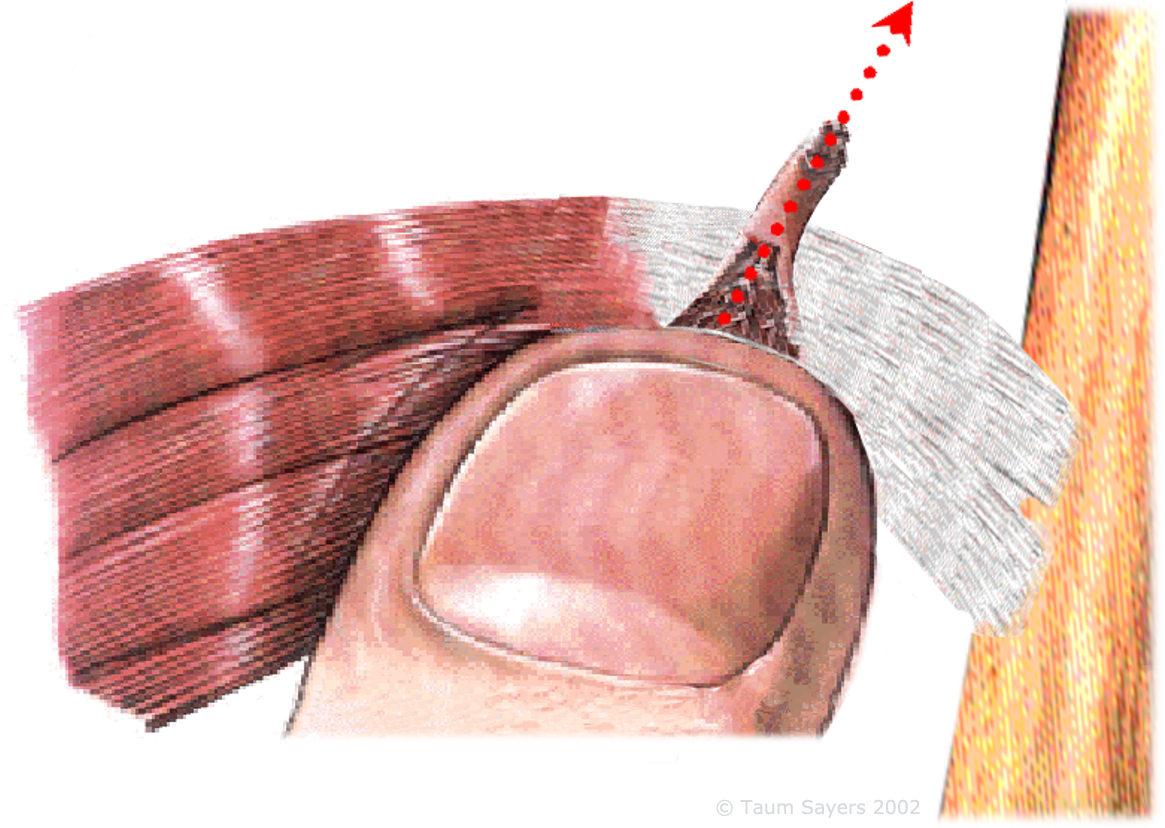 A useful image is one of pushing or nudging dried strings of glue across glass with your fingertips. Consider that the attachment points of the tendon represent a concentration of force in one small area (the entire force of the muscle focuses tension on the bone through the tendon at its attachment). Because of this, the tension/force (pounds per square inch) at the attachment point is higher than at any point in the body of the muscle itself. There are pain receptors at the bone surface (periosteum), which in turn can make the insertion point very sensitive. It is thus helpful to expect these points to be tender and adjust your pressure accordingly. Consider that you are not so much repositioning the fibers to an exact position as much as you are introducing movement towards a balanced situation, thus reducing adhesions and removing distortion. The muscle tissue, upon having the 'duct tape' removed, will most often be able to nestle back to its optimal location. Note that one indication of a misplaced and distorted muscle is when the fibers tactilely 'stand out' with that all too familiar stringy/ropey feeling. Additionally, when muscle fibers are in their most functional position, they usually blend back in with the surrounding fibers and 'tactily disappear'.
The attachment points can serve as an important reference, so after addressing the surrounding regional tensions and distortions within the belly of the tender muscle, you can often return to a previously tender attachment to find it has relaxed. This can also serve to instill confidence in your client that there are benefits to the process.
By applying these techniques, you will have tapped some of the innate intelligence of the body, intentionally encouraging the muscle fiber to release chronic tension by overriding its protective state of contraction via the GTO, thus "reprogramming" it via the nervous system to relax. You will also have encouraged the muscle out of a distorted position and back towards a situation where it has a better opportunity to relax and repair.
This is an excerpt from Taum's article on Mid-Back Tension published in the July 2002 issue of Massage Magazine:
In retrospect, a more accurate title might have been
"Defending the Rhomboids."


Peroneus Brevis
ORIGIN: Distal 2/3 of the lateral surface of the body of the fibula and the adjacent intermuscular septa.
INSERTION: Tuberosity on the lateral side of the base of the 5th metatarsal.
ACTION: Eversion and plantar flexion of the foot at the ankle. Supports lateral stability of the ankle.

Terminology
Origin: The beginning site, the more fixed attachment of the muscle. Can be considered as the anchoring point.
Insertion: The movable attachment of the distal end of the muscle.
Entheses: Locations of stress concentration where tendons and ligaments attach to bone.
Superior: Toward the upper part of the structure.
Inferior: Toward the lower part of the structure.
Anterior: Nearer to the front of the body.
Posterior: Nearer to or at the back of the body.
Medial: Near the midline of the body.
Lateral: Farther from the midline of the body.
Proximal: Near the point of attachment, center of the body.
Distal: Away from the trunk, from the center.
External: Towards the surface of the body.
Internal: Away from the surface of and within the body.
Plantar: Refers to the bottom of the foot.
Dorsal: Refers to the top of the foot.
Unilaterally: Contracting on one side.
Bilaterally: Contracting on both sides.
Inversion: To turn inward.
Eversion: To turn outward.
Synergist: Cooperating and supporting.
Antagonist: That which counteracts, opposes.
Agonist: The muscle directly engaged in contraction.
Proprioceptors: Proprioceptors are specialized sensory receptors that are responsible for providing information about the position, movement, and tension loads of muscles and joints.
For more information: Proprioceptors
Periosteum: The periosteum is a dense highly innervated membrane composed of fibrous connective tissue that closely wraps (invests) all bone, except that of the articulating surfaces in joints which are covered by a synovial membrane.
The periosteum is the most densely innervated, followed by bone marrow and cortex. It is important to recognize and respect the sensitivity of this membrane. It may well be the most sensitive component in the body.
For more information: Sensory Innervation of Human Bone
"Peri-" is a prefix borrowed from the Greek meaning "around or about" and "-osteum" also comes from the Greek, from "osteon" meaning "bone", so periosteum literally means "around the bone."
Golgi Tendon Organ (GTO): A spindle-shaped structure near the muscular/tendinous junction. This structure is thought to function as a feedback system that monitors muscle tension, inhibits muscle contraction of the agonist, and facilitates contraction of the antagonistic muscle. The purpose of this mechanism is to prevent overuse and damage to the muscle and involved joint.


Additional resources for anatomical clarity:


About Muscles.


Taum's approach to manual therapy is primarily influenced by the work of Lauren Berry Sr, Registered Physical Therapist and Structural Engineer.
Structural engineering is a sub-discipline of civil engineering. Structural engineers design the 'bones and muscles' that create the form, shape, and function of structures.
One of Lauren's many unique gifts to the manual therapy world was the concept of soft-tissue balance and distortion.
This is so appropriate:-)
Click here for more information on Lauren.
A Holistic approach.
Corrective Massage recognizes the importance of balanced relationships and interactions throughout the body's soft tissues*. These relationships include natural anatomical positions and functionally balanced movement.
Functional balance implies that our soft tissues are working harmoniously to support pain-free, healthy movement and function.
In Taum's world of Corrective Massage, considering all bodily movement as an orchestration of soft tissue relationships is a fundamental principle and starting point.
These foundational principles include familiarity with Equilibrium and Homeostasis. AKA Balance.
For example: Walking initially appears to be a simple activity. It actually involves a complex orchestration of numerous soft tissues.
A symphony of movement:
Our body requires over 200 of our 600 muscles to take one step. Of those 200, many serve as compensating adapters working in the background to keep us upright as we walk. While all our weight is on the right foot, those background muscles are adapting and counterbalancing so we do not fall over.
Each and every soft tissue plays a vital role in the body's ability to move and adapt to unbalanced tensions.
Our bodies can adapt to those tensions.
But only so far...
Limping is an example of crossing the adaptation line.
Pain serves as an alert that unbalanced tension has exceeded the body's ability to adapt, and corrective therapy is required.
The foundational focus of this unique therapy is to interpret the alert and then identify and correct the soft tissue tensions and imbalances that have created those alerts.
Corrective massage has repeatedly proven to be an efficient and effective method to reduce and relieve pain.
I hope this information serves you and those you serve.
*Muscles, tendons, ligaments, membranes, and viscera.


Terminology
Origin: The beginning site, the more fixed attachment of the muscle. Can be considered as the anchoring point.
Insertion: The movable attachment of the distal end of the muscle.
Entheses: Locations of stress concentration where tendons and ligaments attach to bone.
Superior: Toward the upper part of the structure.
Inferior: Toward the lower part of the structure.
Anterior: Nearer to the front of the body.
Posterior: Nearer to or at the back of the body.
Medial: Near the midline of the body.
Lateral: Farther from the midline of the body.
Proximal: Near the point of attachment, center of the body.
Distal: Away from the trunk, from the center.
External: Towards the surface of the body.
Internal: Away from the surface of and within the body.
Plantar: Concerning the sole of the foot.
Dorsal: Concerning the back of the foot.
Unilaterally: Contracting on one side.
Bilaterally: Contracting on both sides.
Inversion: To turn inward.
Eversion: To turn outward.
Synergist: Cooperating and supporting.
Antagonist: That which counteracts, opposes.
Agonist: The muscle directly engaged in contraction.
Periosteum: The periosteum is a dense highly innervated membrane composed of fibrous connective tissue that closely wraps (invests) all bone, except that of the articulating surfaces in joints which are covered by a synovial membrane.
The periosteum is the most densely innervated, followed by bone marrow and cortex. It is important to recognize and respect the sensitivity of this membrane. It may well be the most sensitive component in the body.
For more information: Sensory Innervation of Human Bone
"Peri-" is a prefix borrowed from the Greek meaning "around or about" and "-osteum" also comes from the Greek, from "osteon" meaning "bone", so periosteum literally means "around the bone."
Golgi Tendon Organ (GTO): A spindle-shaped structure near the muscular/tendinous junction. This structure is thought to function as a feedback system that monitors muscle tension, inhibits muscle contraction of the agonist, and facilitates contraction of the antagonistic muscle. The purpose of this mechanism is to prevent overuse and damage to the muscle and involved joint.

Note that the clearer your question, the clearer my response.
Click here to email your question.
or
Call and leave a message: 530-587-6816