
Learning Lunch:
Repetitive de-stressors for your upper back and neck.
This webpage serves as your homework so that as we do this together, we are all on the same planet speaking the same language.
Theracane = Magic wand.

This learning lunch presentation offers techniques, protocols, and foundational information for de-stressing your upper back & neck and learning the art of Theracaning. (Is 'Theracaning' a word?).
Your homework does not require memorizing anything.
Our common goal is for you to watch, read, and, at minimum, become familiar.


Consider...Our nervous system weaves its way throughout our muscular system. Might relaxing tension surrounding our nervous system (PNS) have benefits? Hmmm...
This PNS (Parasympathetic Nervous System) influences several important organs and functions in the body, primarily involved in the "rest and digest" response. It counteracts the "fight or flight" response of the sympathetic nervous system. Some of the organs and functions controlled by the parasympathetic nervous system include:
1. Heart: The parasympathetic nervous system slows down the heart rate, reducing blood pressure and promoting rest and relaxation.
2. Lungs: It helps regulate breathing by constricting bronchial airways and reducing the rate of respiration.
3. Gastrointestinal system: The parasympathetic system stimulates digestion and nutrient absorption by increasing saliva production, promoting peristalsis (the movement of food through the digestive tract), and enhancing the release of digestive enzymes.
4. Stomach: It increases gastric acid secretion and motility, which aids in breaking down food.
5. Pancreas: The parasympathetic system stimulates the release of insulin, which helps regulate blood sugar levels.
6. Liver: It promotes the storage of glucose and the synthesis of glycogen.
7. Bladder: It stimulates the contraction of the bladder for urination.
8. Genitalia: The parasympathetic system is involved in sexual arousal and is responsible for the engorgement of genital organs.
9. Eye: It constricts the pupil and facilitates accommodation for near vision.
10. Salivary glands: It stimulates the production of saliva.
11. Exocrine glands: It can activate various exocrine glands, including sweat and digestive glands.
The parasympathetic nervous system helps the body return to a state of rest and recovery after a stressor or physical activity. It works in opposition to the sympathetic nervous system, which prepares the body for "fight or flight" responses in times of stress or danger.

Intention and Imagination.
"Repositioning"
Corrective Massage recognizes that muscles, tendons, ligaments, and viscera have optimum anatomical positions, functions, relationships, and movement patterns.
Correcting soft tissue misplacement and distortion is at the core of this amazing work.
Sometimes it's as simple as putting things back where they belong.
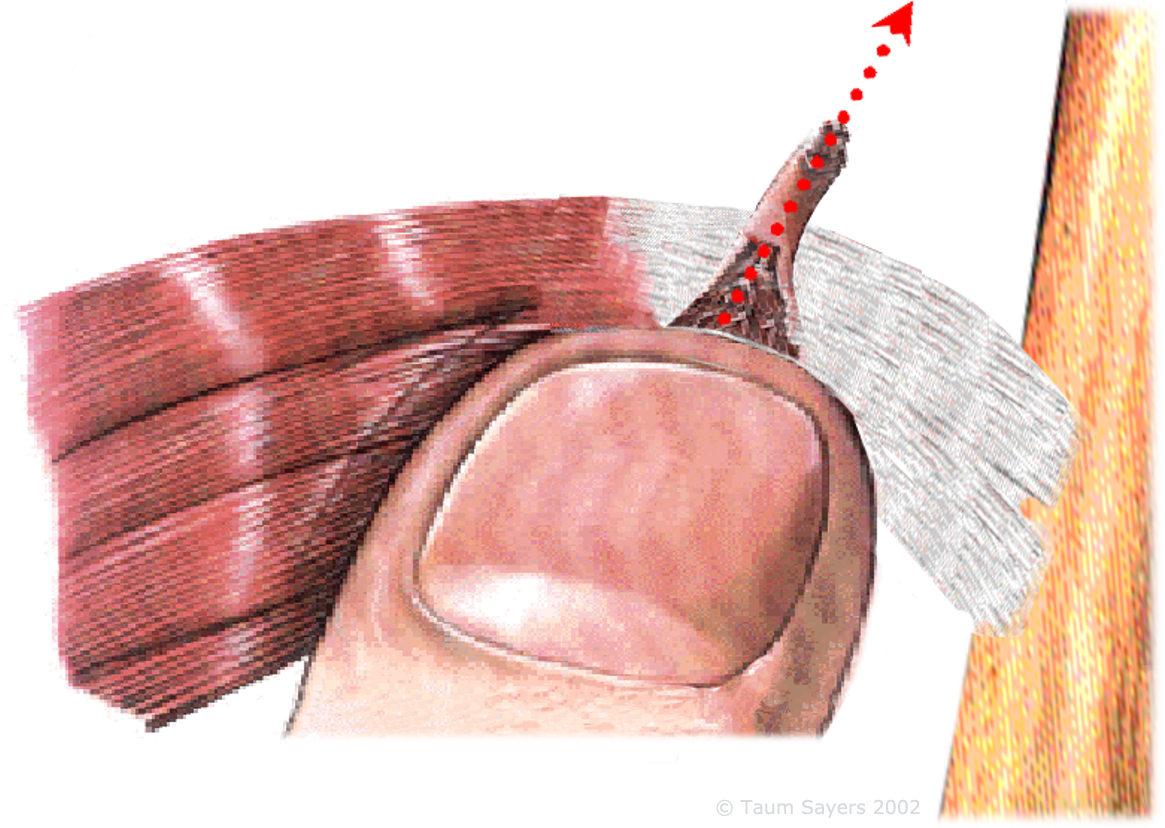 A useful image is one of pushing or nudging dried strings of glue across glass with your fingertips. Consider that the attachment points of the tendon represent a concentration of force in one small area (the entire force of the muscle focuses tension on the bone through the tendon at its attachment). Because of this, the tension/force (pounds per square inch) at the attachment point is higher than at any point in the body of the muscle itself. There are pain receptors at the bone surface (periosteum), which in turn can make the insertion point very sensitive. It is thus helpful to expect these points to be tender and adjust your pressure accordingly. Consider that you are not so much repositioning the fibers to an exact position as much as you are introducing movement towards a balanced situation, thus reducing adhesions and removing distortion. The muscle tissue, upon having the 'duct tape' removed, will most often be able to nestle back to its optimal location. Note that one indication of a misplaced and distorted muscle is when the fibers tactilely 'stand out' with that all too familiar stringy/ropey feeling. Additionally, when muscle fibers are in their most functional position, they usually blend back in with the surrounding fibers and 'tactily disappear'.
The attachment points can serve as an important reference, so after addressing the surrounding regional tensions and distortions within the belly of the tender muscle, you can often return to a previously tender attachment to find it has relaxed. This can also serve to instill confidence in your client that there are benefits to the process.
By applying these techniques, you will have tapped some of the innate intelligence of the body, intentionally encouraging the muscle fiber to release chronic tension by overriding its protective state of contraction via the GTO, thus "reprogramming" it via the nervous system to relax. You will also have encouraged the muscle out of a distorted position and back towards a situation where it has a better opportunity to relax and repair.
This is an excerpt from Taum's article published in the July 2002 issue of Massage Magazine on Mid-Back Tension.*
Click here for the full article: "Intention and Imagination"
In retrospect, a more accurate title might have been
"Defending the Rhomboids."
This self-help class offers efficient and effective 'do-it-yourself' remedial techniques to reduce upper back and neck pain.
It's relatively simple.
Muscles can become 'stuck.'
Stuck muscles create tension.
Tension creates pain.
This class is about reducing tensions in the upper back and neck.
Relief may be easier than you think.
Consider:
Manual therapies share the common goal of moving stuck tissue.
The intention and goal for this class is for you to learn, remember, and feel how to do 3 remedial movements to reduce and prevent neck strain. They can serve you as both a response when your neck is talking to you with the 'tension and pain' signals and as preventative healthy habits.
This approach has evolved from studying, practicing, sharing, and teaching The Lauren Berry Method® of Corrective Massage for over 40 years.
This class is for you if you seek knowledge and effective 'do-it-yourself' remedial techniques to reduce upper back and neck pain.
What to bring:
Come prepared, wearing comfortable clothing so you can move without restrictions and a yoga pad. (I will bring several to use during class.)
A really handy self-help tool:

The Thera Cane can be very efficient and effective for getting stuck muscles to start moving... especially in your mid and upper back, which directly affects the neck region.
If you do not have a Thera Cane currently, you should consider acquiring one before class to bring with you. If supplies are available, there may be several available for purchase at class for $30. Give me a heads-up if you want one. Please arrive a few minutes early.
They are also available here.