
Corrective Massage for Re-balancing the Knee.
Date: Saturday-Sunday in Reno
March 28th-29th
 1055 W Moana Ln #202 (upstairs)
To complete your registration, please email Taum with the name you would like printed on your Knee Class certificate.
Please submit the name exactly as you want it to appear on your certificate.
Click here to send your certificate nameOnce this is submitted, you’re all set.
CE Credit Note
The NCBTMB recognizes this class as:
“Muscle Management for Knee Problems and Injuries”
CE Hours: 13.00
Provider name: Taum Sayers.
Approved Provider#: 152386-00
Use this information for your CE credit submission.
Preparation overview:
This preparation page is intended to support your intellectual connection to the anatomical and physiological material, clarify key concepts, and help you enter class ready to focus on the tactile components.
This is not about memorizing.
Simply watch and read...
Hamstring Floor Stretch — A Simple Measure of Knee Balance.
This is included not as a flexibility exercise, but as a way to observe how each knee tolerates extension and load through the posterior chain.
Taum's anatomy view
All of these tissues influence the Knee:
- The Medial Collateral Ligament (MCL).
- Cruciate ligament.
- Biceps Femoris.
- Popliteus.
- Plantaris.
- Quadriceps femoris muscle group.
- Sartorius, Gracilis, Semitendinosus (Pes Anserinus Muscles).
- Medial meniscus.

The Joint Capsule of the Knee
The Knee joint is a complex structure that relies heavily on the joint capsule for stability and function. The fibrous knee joint capsule encloses the knee joint and plays a crucial role in providing stability, protecting the joint from external forces, and allowing for smooth movement.
Key Components Involved:
- Menisci: Crescent-shaped cartilage that improves load distribution and enhances joint congruity.
- Ligaments (ACL, PCL, MCL, LCL): These ligaments work with the joint capsule to provide dynamic and static stability.
- Muscles and Tendons: The surrounding muscles, especially the quadriceps and hamstrings, play an active role in moving the knee, while the joint capsule limits excessive movements.
These fibrous layers that form the knee joint capsule resist excessive movements, while the synovial inner layer ensures lubrication and nourishment. Together, these components protect the knee joint, support its function during various activities, and maintain the health of its internal structures.


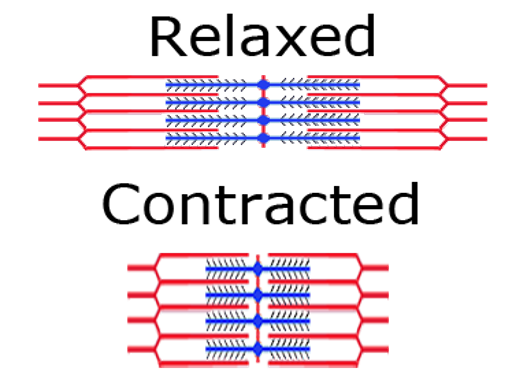
The sarcomere is the basic functional unit of a muscle fiber and is responsible for muscle contraction. It consists of alternating thick and thin filaments that slide past each other to produce contraction.



Taum's approach to manual therapy is primarily influenced by the work of Lauren Berry Sr, Registered Physical Therapist and Structural Engineer.
Structural engineering is a sub-discipline of civil engineering. Structural engineers design the 'bones and muscles' that create the form, shape, and function of structures.
They also work with and understand the plumbing systems within those structures.
One of Lauren's many unique gifts to the manual therapy world was the concept of soft-tissue balance and distortion.
This is so appropriate:-)
Click here for more information on Lauren.
A Holistic approach.
It serves to remember that we, as therapists, do not heal anything. We simply recognize, respect, and support the body's 'built-in' healing ability.
Corrective Massage recognizes the importance of balanced relationships, movements, and interactions throughout the body's soft tissues*. These relationships include natural anatomical positions and functionally balanced movement unimpeded by soft tissue tension.
Functional balance implies that our soft tissues are working harmoniously to support pain-free, healthy movement and function.
In Taum's world of Corrective Massage, considering all bodily movement as an orchestration of soft tissue relationships is a fundamental principle and starting point.
These foundational principles include familiarity with Equilibrium and Homeostasis. AKA Balance.
For example: Walking initially appears to be a simple activity. It actually involves a complex orchestration of numerous soft tissues.
A symphony of movement:
Our body requires over 200 of our 600 muscles to take one step. Of those 200, many serve as compensating adapters working in the background to keep us upright as we walk. While all our weight is on the right foot, those background muscles are adapting and counterbalancing so we do not fall over.
Each and every soft tissue plays a vital role in the body's ability to move and adapt to unbalanced tensions.
Our bodies can adapt to those tensions.
But only so far...
Limping is an example of crossing the adaptation line.
Pain serves as an alert that unbalanced tension has exceeded the body's ability to adapt, and corrective therapy is required.
The foundational focus of this unique therapy is to interpret the alert and then identify and correct the soft tissue tensions and imbalances that have created those alerts.
Corrective massage has repeatedly proven to be an efficient and effective method to reduce and relieve pain.
I hope this information serves you and those you serve.
*Muscles, tendons, ligaments, membranes, and viscera.
Terminology
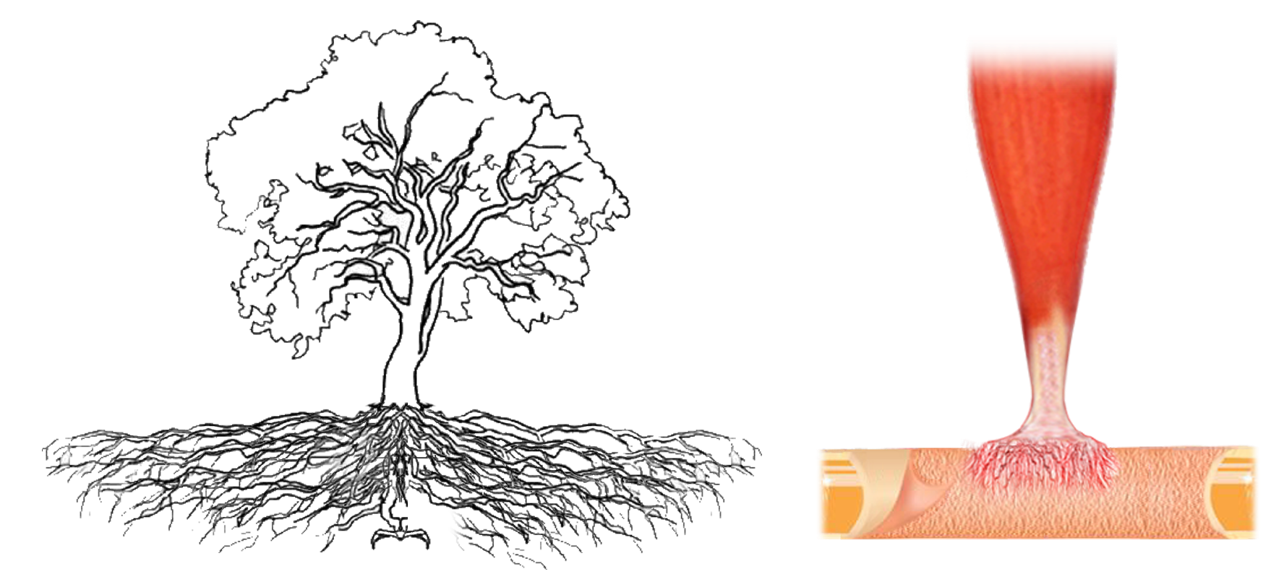
Entheses: Locations of stress concentration where tendons and ligaments attach to bone.
Origin: The beginning site, the more fixed attachment of the muscle. Can be considered as the anchoring point.
Insertion: The movable attachment of the distal end of the muscle.
Semi: Latin for "half" or "partial." It is commonly used to describe structures that are partially or incompletely formed or that exist in a half state.
Superior: Toward the upper part of the structure.
Supra: Indicates a position that is above or over another structure.
Inferior: Toward the lower part of the structure.
Anterior: Nearer to the front of the body.
Posterior: Nearer to or at the back of the body.
Medial: Near the midline of the body.
Lateral: Farther from the midline of the body.
Proximal: Near the point of attachment, center of the body.
Distal: Away from the trunk, from the center.
External: Towards the surface of the body.
Internal: Away from the surface of and within the body.
Plantar: Refers to the bottom of the foot.
Dorsal: Refers to the top of the foot.
Unilaterally: Contracting on one side.
Bilaterally: Contracting on both sides.
Inversion: To turn inward.
Eversion: To turn outward.
Synergist: Cooperating and supporting.
Antagonist: That which counteracts, opposes.
Agonist: The muscle directly engaged in contraction.
Proprioceptors: Proprioceptors are specialized sensory receptors that are responsible for providing information about the position, movement, and tension loads of muscles and joints.
For more information: Proprioceptors
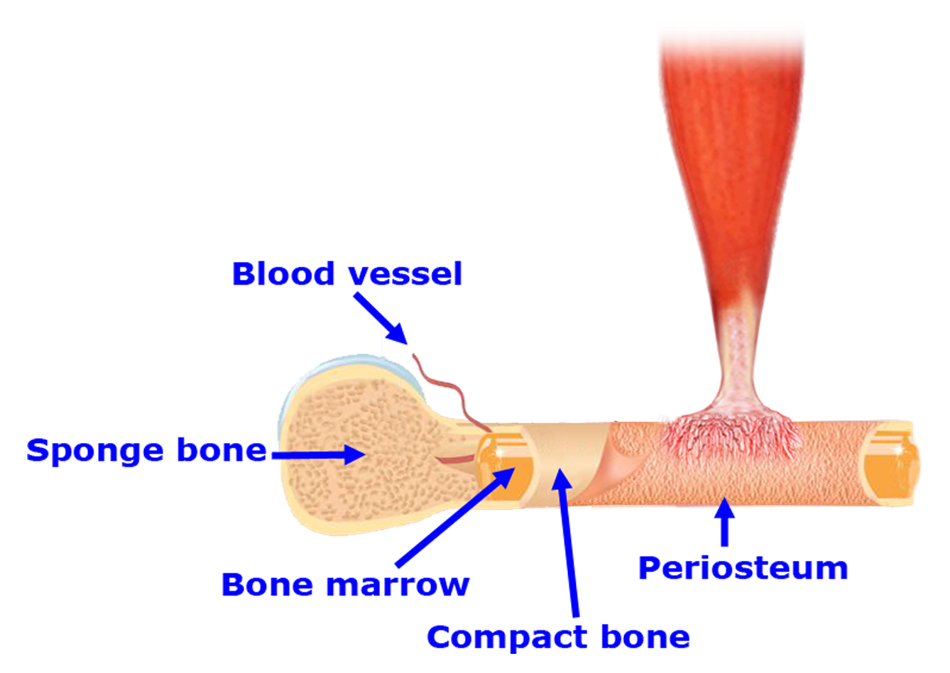
Periosteum: The periosteum is a dense highly innervated membrane composed of fibrous connective tissue that closely wraps (invests) all bone, except that of the articulating surfaces in joints which are covered by a synovial membrane.
The periosteum is the most densely innervated, followed by bone marrow and cortex. It is important to recognize and respect the sensitivity of this membrane. It may well be the most sensitive component in the body.
For more information: Sensory Innervation of Human Bone
"Peri-" is a prefix borrowed from the Greek meaning "around or about" and "-osteum" also comes from the Greek, from "osteon" meaning "bone", so periosteum literally means "around the bone."
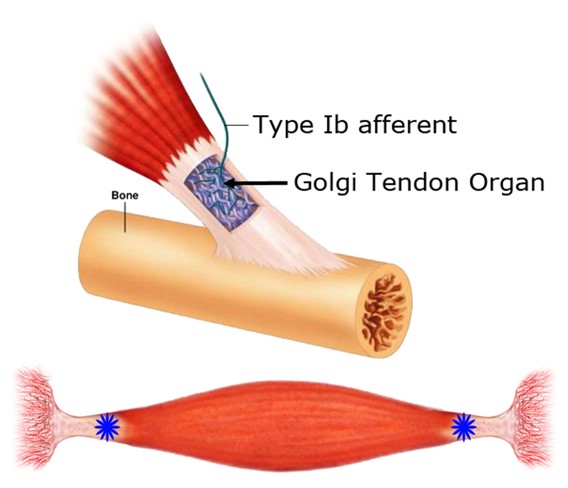
Golgi Tendon Organ (GTO): A spindle-shaped structure near the muscular/tendinous junction. This structure is thought to function as a feedback system that monitors muscle tension, inhibits muscle contraction of the agonist, and facilitates contraction of the antagonistic muscle. The purpose of this mechanism is to prevent overuse and damage to the muscle and involved joint.
Taum's Anatomy Reference


