
"Repositioning"
Part of the uniqueness of this corrective bodywork is found in correcting soft tissue misplacement and distortion.
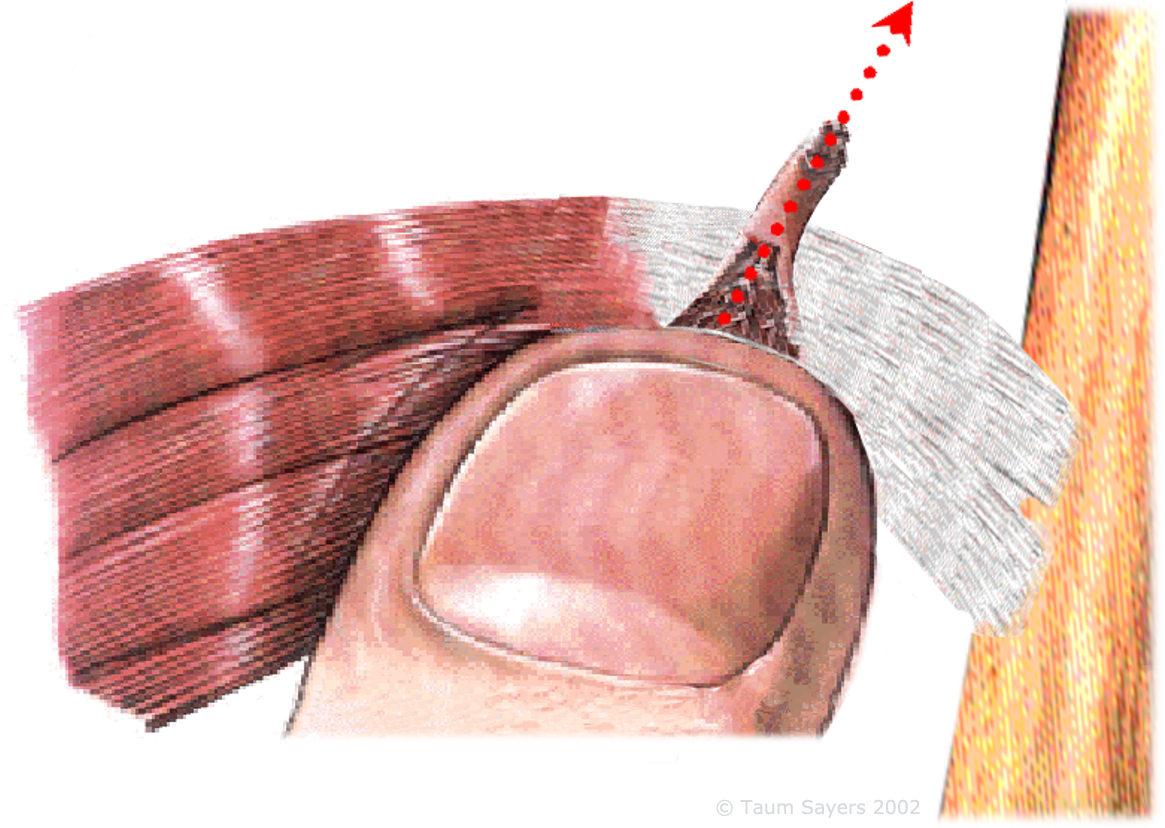 A useful image is one of pushing or nudging dried strings of glue across glass with your fingertips. Consider that the attachment points of the tendon represent a concentration of force in one small area (the entire force of the muscle focuses tension on the bone through the tendon at its attachment). Because of this, the tension/force (pounds per square inch) at the attachment point is higher than at any point in the body of the muscle itself. There are pain receptors at the bone surface (periosteum), which in turn can make the insertion point very sensitive. It is thus helpful to expect these points to be tender and adjust your pressure accordingly. Consider that you are not so much repositioning the fibers to an exact position as much as you are introducing movement towards a balanced situation, thus reducing adhesions and removing distortion. The muscle tissue, upon having the 'duct tape' removed, will most often be able to nestle back to its optimal location. Note that one indication of a misplaced and distorted muscle is when the fibers tactilely 'stand out' with that all too familiar stringy/ropey feeling. Additionally, when muscle fibers are in their most functional position, they usually blend back in with the surrounding fibers and 'tactily disappear'.
The attachment points can serve as an important reference, so after addressing the surrounding regional tensions and distortions within the belly of the tender muscle, you can often return to a previously tender attachment to find it has relaxed. This can also serve to instill confidence in your client that there are benefits to the process.
By applying these techniques, you will have tapped some of the innate intelligence of the body, intentionally encouraging the muscle fiber to release chronic tension by overriding its protective state of contraction via the GTO, thus "reprogramming" it via the nervous system to relax. You will also have encouraged the muscle out of a distorted position and back towards a situation where it has a better opportunity to relax and repair.
This is an excerpt from Taum's article published in the July 2002 issue of Massage Magazine on Mid-Back Tension.
Click here for the full article: "Intention and Imagination"